
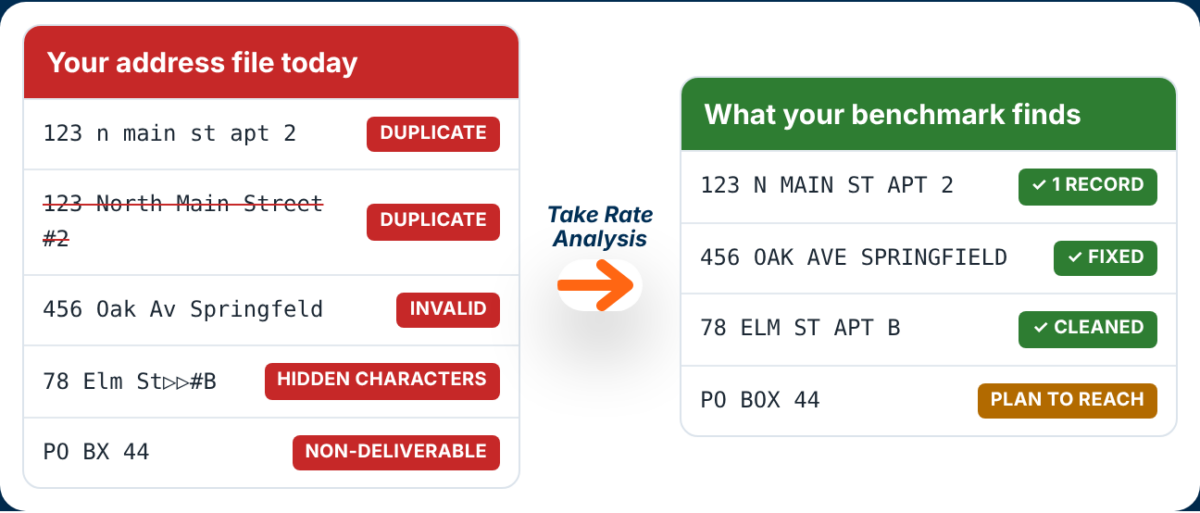
Every ISP tracks take rate: customers divided by homes passed. It drives build decisions, marketing budgets and what you tell investors. But the number is only as good as the address list behind it, and most homes-passed lists have problems nobody has looked for.
Where homes-passed lists go wrong
- Duplicates. “123 N Main St Apt 2” and “123 North Main Street #2” are the same home, counted twice. One parcel can show up three or four times.
- Invalid addresses. Misspelled streets, wrong ZIP codes and old rural route addresses that no longer exist.
- Hidden data problems. Stray control characters, concatenated fields and missing unit numbers that standardization turns up.
- Addresses that won’t take mail. Vacant lots, seasonal homes and addresses USPS doesn’t deliver to.
Each one inflates homes passed. Inflate the denominator and your take rate looks worse than it is, so you can’t tell which neighborhoods are actually underperforming.
Why it matters for marketing
The same list usually feeds your marketing. Mail a list full of duplicates and undeliverables, and you pay to print and post pieces that never reach a prospect. Automate that list, and the waste repeats every cycle.
Find your real number
Clean the data first: standardize every address to one USPS format, validate it, remove duplicates and flag the non-deliverables. Then overlay your active customers. What’s left is your true take rate, and a clear view of where your marketing should go.
That’s what our free Take Rate Analysis does for qualifying fiber and fixed wireless ISPs: a benchmark of your address data and your true take rate, ZIP by ZIP. We put a mutual NDA in place before you send anything, and your files are never shared or sold.